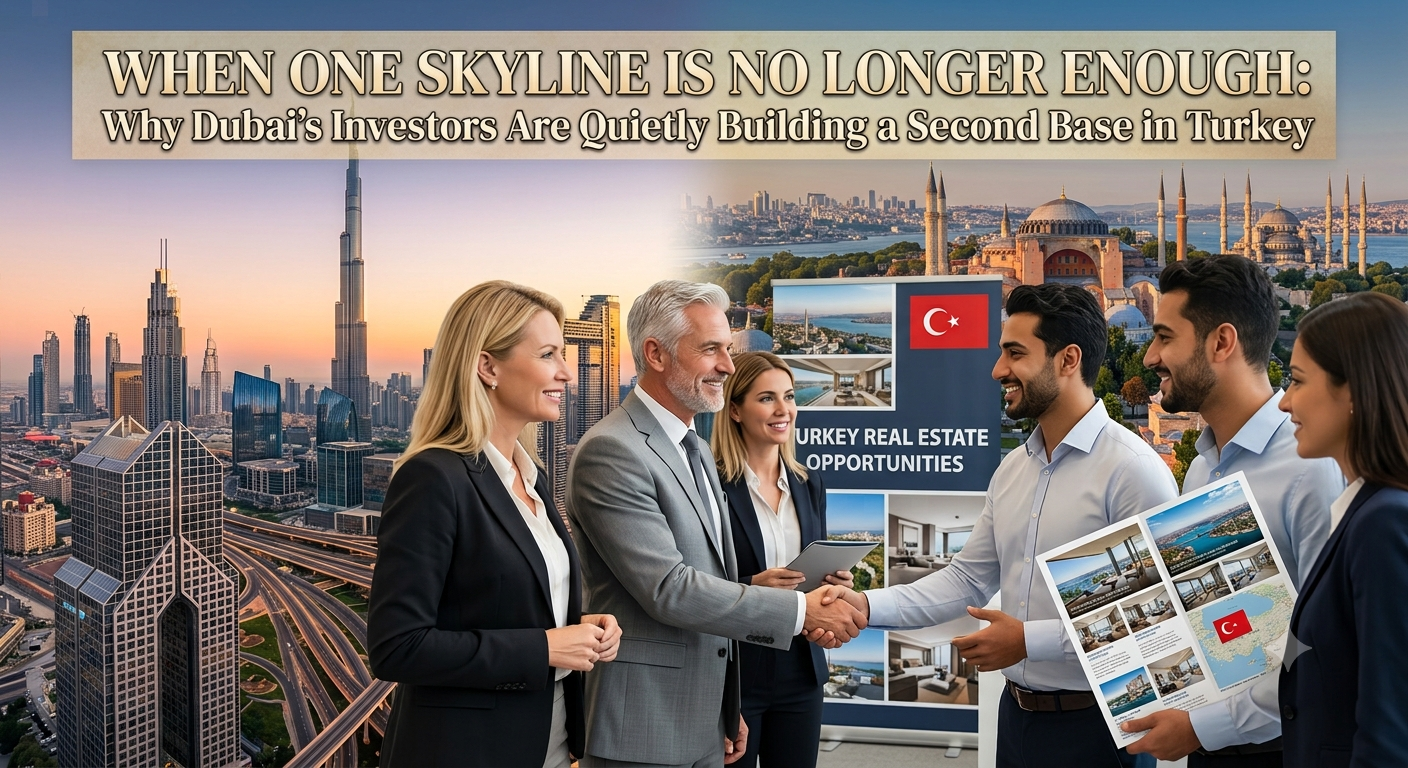
There is a certain type of investor who does not make headlines. They operate quietly, build wealth across borders, and rarely bet everything on a single city — no matter how successful that city has been.
For more than a decade, Dubai has been their first choice: tax-free, dynamic, and globally connected. It remains all of those things. But in conversations happening right now across wealth management circles in the Gulf, South Asia, and the wider diaspora, a second name is increasingly coming up.
Turkey. Not as a replacement. Not as an escape. But as the missing piece in a portfolio built for the long run.
At a Glance: Why Dubai Investors Are Looking at Turkey
- Dubai remains a top-tier investment market — this is not a story about leaving it behind.
- Savvy investors now seek country-level diversification, not just asset diversification.
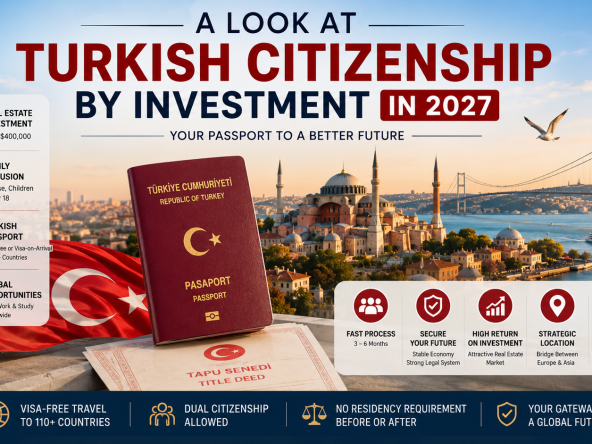
- Turkey’s Citizenship by Investment (CBI) programme requires a minimum $400,000 USD property purchase.
- Turkish citizenship covers the investor, their spouse, and dependent children under 18.
- The passport grants visa-free or visa-on-arrival access to 110+ countries including Japan, South Korea, and Singapore.
- Istanbul property prices average $2,500–$3,500 per m² — less than half of Dubai’s $6,000 average.
- Turkey’s real estate market is entering an early recovery phase, historically a strong entry point.
- The strongest interest comes from Gulf-based families, South Asian HNWIs, and globally mobile entrepreneurs.
The Question Every Smart Investor Is Now Asking
Diversification used to mean spreading money across different asset types — equities, real estate, fixed income. That approach has not changed. But a new layer has been added: geographic diversification at the country level.
The catalyst is not panic. It is the quiet acknowledgement, reinforced by recent years of geopolitical turbulence, that even the most stable jurisdictions carry country-specific risk. Drone strikes, policy shifts, residency regulations tied to employment — these are not abstract risks for Gulf-based families. They are lived realities.
“What happens if circumstances change?” is no longer a pessimistic question. It is the defining question of modern wealth planning.
The search for a second base — a country where assets, residency rights, and long-term options can be held independently of any single employer, government, or regional climate — is accelerating. Turkey has emerged as the answer that makes the most strategic sense.
Dubai Is Not Losing Ground — It Is Gaining Competition
Let us be precise: Dubai’s real estate market is not weakening. Between 2021 and 2024, average residential values climbed approximately 20% in a single year, while luxury areas in some districts recorded gains of up to 40%. Off-plan transactions account for more than 60% of all sales, a figure that reflects both investor confidence and sustained market liquidity.
Population growth, world-class infrastructure, and zero income tax continue to attract high-net-worth individuals from every corner of the globe. Dubai will remain a cornerstone of international property portfolios.
But here is the shift: investors who have already built positions in Dubai are no longer asking ‘where else in the UAE?’ They are asking ‘where else in the world?’ And the answer, with increasing frequency, is Turkey.
Dubai vs. Turkey: A Strategic Comparison
| Factor | Dubai | Turkey |
| Property price / m² | ~$6,000 USD | ~$2,500–$3,500 USD |
| Citizenship route | Not available | $400K investment |
| Citizenship timeline | N/A | 3–6 months |
| Family inclusion | N/A | Spouse + children <18 |
| Passport access | UAE visa required | 110+ countries visa-free |
| Market cycle (2025) | Mature / high growth | Early recovery / tightening |
| Primary appeal | Liquidity & yield | Security & mobility |
Three Investor Profiles Driving the Trend
1. Gulf-based professionals and business owners
These investors have built careers and businesses in the UAE, often over many years. But Gulf residency is typically linked to employment or business sponsorship — a structure that can change with circumstance. Turkish citizenship, passed down to their children, offers something the UAE cannot: permanence that is independent of any employer or visa regime.
2. South Asian high-net-worth individuals
Investors from India, Pakistan, and Bangladesh have historically driven a significant share of Dubai’s international real estate market. Turkey now offers them a parallel opportunity: property ownership combined with an international passport and multi-generational family security. The combination of tangible asset, strong yield, and citizenship is rare at this price point.
3. Globally mobile entrepreneurs
For entrepreneurs managing businesses, teams, and assets across multiple jurisdictions, holding a single passport creates friction. Turkey’s passport — offering visa-free or visa-on-arrival access to more than 110 countries — reduces that friction meaningfully. Combined with Turkey’s scale as a domestic economy, the citizenship carries real strategic weight.
The Macro Picture Is Shifting in Turkey’s Favour
This is not simply a narrative built on anecdote. The macroeconomic signals are notable. Fitch Ratings upgraded Turkey’s sovereign credit rating to BB- from B+ in January 2026, the second upgrade in six months, citing improving policy credibility and stabilising macroeconomic conditions. Turkey’s Finance Minister confirmed in September 2025 that the country’s disinflation process is on track, with single-digit inflation targeted by 2027.
The World Bank has noted resilient private consumption, and Turkey’s rental yields averaged 7.41% in Q1 2025. Home sales in April 2025 were 56.6% higher year-on-year, suggesting that domestic demand is already returning ahead of any rate cuts.
These are the conditions that precede a property cycle, not follow one.
“Turkey is not replacing Dubai in these portfolios. It is completing them”
Frequently Asked Questions
- Are investors abandoning Dubai for Turkey?
No. The vast majority are not replacing Dubai — they are diversifying beyond it. Turkey is being added as a second pillar, not substituted for the first.
- What makes Turkey’s citizenship programme unique?
Very few countries offer full citizenship through a real estate investment at this threshold, in a country of Turkey’s economic and geopolitical size. Most comparable programmes are smaller island nations with limited economic footprint.
- What is the minimum property investment required?
The real estate route requires a minimum purchase of $400,000 USD, held for at least three years. The property is a genuine asset — not a non-refundable donation.
- Who is included in the citizenship application?
The main applicant, their spouse, and dependent children under the age of 18 are all covered within the same application.
- How long does the process take?
Typically, three to six months from the date of property purchase to Turkish passport issuance.
- Why does Turkey appeal specifically to Muslim investors and Gulf families?
Cultural and religious familiarity plays a role. Business networks between Turkey and the Gulf are deep and long-established. Istanbul is a well-known destination for Gulf tourism. For Muslim families, Turkey also offers alignment in lifestyle, halal infrastructure, and cultural values.
- Is now a good time to invest in Turkish real estate?
Historically, the most favourable entry points have come during monetary tightening phases, before domestic borrowing recovers. Turkey is currently in that phase. Multiple previous easing cycles produced property gains of 38–60% in Istanbul. The window to enter before the next cycle is open, but it is not indefinite.
Closing Thought
The world’s most experienced investors have always understood one principle: do not depend on a single jurisdiction. Wealth should be structured so that a change in one country’s politics, economy, or regulation does not unravel everything that has been built.
For those who already hold property in Dubai, Turkey offers a logical and powerful complement: a second citizenship, a second asset base, and a second set of options. All secured through a single real estate purchase in Turkey one of the world’s most strategically positioned countries.
The skyline of one city built what you have. A second one may be what protects it.