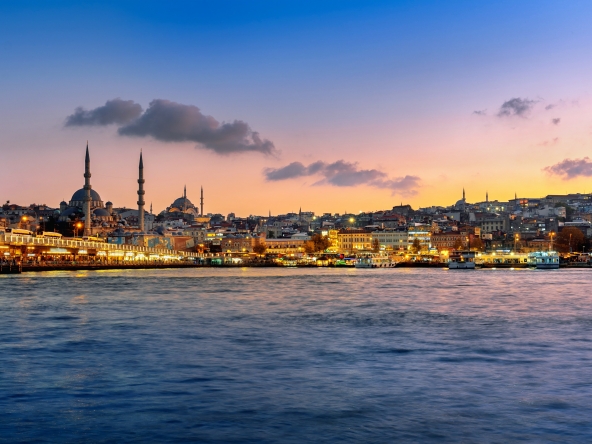

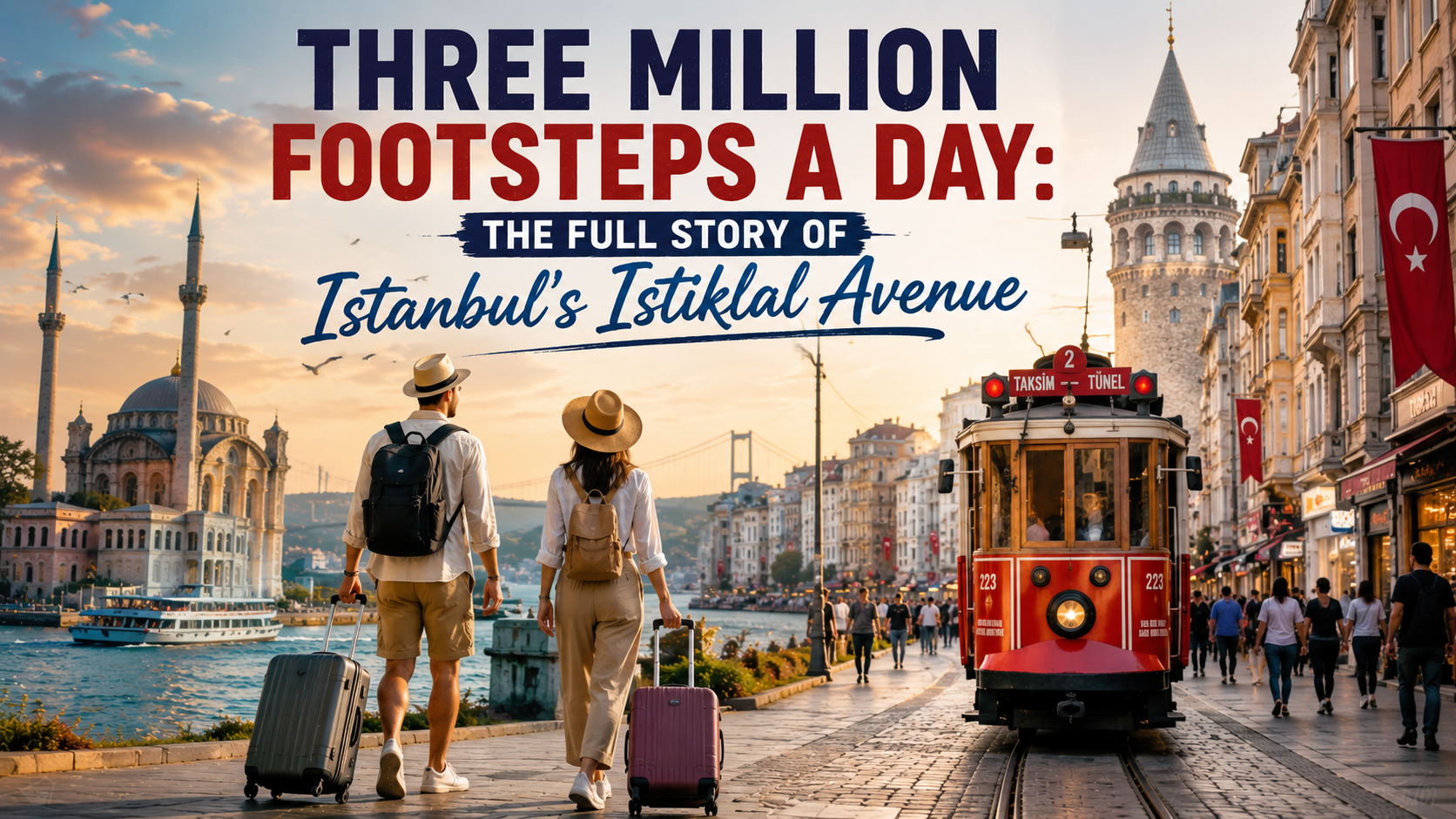
There is a street in Istanbul where the Ottoman Empire once entertained European diplomats, where Russian émigrés sold flowers to survive a revolution, where a nostalgic red tram still rolls through crowds three million strong — and where you can eat a fish sandwich, visit a whirling dervish museum, and stumble into a nineteenth-century flower market all within the same afternoon.
That street is İstiklal Caddesi. And it is unlike anywhere else on earth.
Stretching just over a mile through the Beyoglu district of European Istanbul — from the lower Tunnel Square all the way up to the vast open expanse of Taksim Square — Istiklal is simultaneously a historic monument, a shopping boulevard, a cultural corridor, and the daily commute of millions. It is Turkey’s busiest street by a margin that no other street in the country comes close to challenging.
This guide covers everything worth knowing: the history, the landmarks, the hidden side streets, the food, and the moments most visitors miss entirely.
At a Glance
| Detail | Information |
| Location | Beyoglu district, European Istanbul |
| Length | Just over 1 mile (Tunnel Sq. to Taksim Sq.) |
| Daily foot traffic | ~3 million people |
| Current name since | 1923 (means ‘Independence’) |
| Best time to visit | Weekday mornings for fewer crowds |
| Nearest metro | Taksim (M2 line) |
| Historic tram | Nostalgic red tram (Tunel–Taksim) |
| Neighbourhood feel | Modern, cosmopolitan, cultural |
From Grande Rue de Pera to the Street of Independence
To understand Istiklal today, you need to understand what it once was — and who walked it before you.
During the height of the Ottoman Empire, the avenue was known as Grande Avenue or Cadde-i Kebir, and later Grand Rue de Pera by the European community that flocked to its embassies, salons, and social gatherings. The name ‘Pera’ itself comes from the Greek word meaning ‘across’ or ‘beyond’ — a reference to the street’s position across the Golden Horn from the old city of Constantinople, now Sultanahmet.
In the 19th century, this was Istanbul’s cosmopolitan centre: Levantine merchants, European diplomats, and the Ottoman elite mingling in one of the most culturally layered streets in the world. Embassies stationed themselves here. Restaurants hosted the city’s power conversations. Name-dropping was not just common — it was the currency of social capital.
The First World War ended that gilded era. The Turkish Independence War reshaped the country, and in 1923, the street was renamed İstiklal Caddesi — meaning Independence Avenue — to reflect the birth of the Turkish Republic.
Neglect followed in the 1970s, and the street fell into disrepair. But the restoration that came in subsequent decades was thorough: new shopkeepers arrived, hotels opened, property investors moved in, and the nostalgic red tram — now one of the street’s most photographed symbols — was returned to service.
“The street did not survive history by accident. It survived because Istanbul kept reinventing it.”
Taksim Square: Where the Street Ends and the City Opens Up
Istiklal Avenue reaches its northern conclusion at Taksim Square, one of Istanbul’s most recognisable open spaces and a symbolic heart of modern Turkey.
The name ‘Taksim’ means ‘division’ or ‘distribution’ in Turkish, a reference to the historic crossroads of several major roads that once converged here. The square dates from the late Ottoman period and has since become the site of major national events, celebrations, and demonstrations.
The most striking monument in the square is the İstiklal Anıtı — the Independence Monument — erected in 1928. A tall column topped with a statue of Mustafa Kemal Atatürk, founder of modern Turkey, it commemorates the Turkish War of Independence and remains one of the city’s most visited sites.
Adjacent to the square sits the Atatürk Cultural Centre, a venue for artistic performances and exhibitions that also marks the transition from the energy of the street to the scale of the square.
The Landmarks Worth Your Time
- Gezi Park
Positioned beside Taksim Square, Gezi Park is small, green, and deliberately low-key. Known internationally for the 2013 protests over plans to build a shopping mall on the site, the park carries significant local meaning. It was originally an army barracks and later revealed to have had a cemetery on its northern side.
Do not come here for grand sights. Come here to sit on a bench in the shade, watch Istanbul move around you, and decompress after the intensity of the avenue.
- Saint Anthony of Padua Catholic Church
Built in the early 20th century in Italian neo-Gothic style, the Church of Saint Anthony of Padua is one of Istanbul’s most important active places of worship. Sunday services are still held here. Even travellers with no religious interest find themselves stopping at the exterior: the red-brick façade and ornate stonework stand out markedly against the commercial buildings surrounding it.
Inside, the architecture rewards a slow look. A statue of Pope John XXIII stands on the grounds. The church is open to visitors, but it remains an active house of worship — silence and respect are expected.
Further along the avenue, close to Galatasaray Square, the Hagia Triada Greek Orthodox Church offers a complementary perspective. Dating from the late 19th century, it features Byzantine-influenced architecture with a prominent dome, representing Istanbul’s deep layers of religious and cultural history.
- Flower Passage — Çiçek Pasağı
One of the most atmospheric places along the entire street, Çiçek Pasağı began life as a 19th-century theatre. A fire gutted much of its interior. After restoration, the ground floor became shops while the upper-level housed offices. When Russian immigrants fleeing the Bolshevik Revolution arrived in Istanbul, many rented the shop spaces and sold flowers to make ends meet — giving the passage its name.
By the 1960s, the flower sellers had given way to traditional meyhanes: old Ottoman-style taverns serving workers, artists, and intellectuals with Turkish mezes and raki. That tradition persists today. Walking through the narrow entrance into the long L-shaped corridor, visitors look upward at the dome-shaped glass ceiling before noticing the second floor lined with black-and-white portrait photographs of old regulars.
- Galata Whirling Dervish Museum
The whirling dervishes — practitioners of Sufism whose slow, spinning sema ceremony has become one of Turkey’s most iconic images — were once suppressed following the dissolution of the Ottoman Empire. Their meeting houses were abandoned and fell apart. In time, attitudes changed, and the old tekkes (lodges) were carefully restored to preserve the memory of the people who lived and practised there.
The museum on Istiklal Avenue presents the ethnographic life of the dervishes through musical instruments, ancient manuscripts, personal objects, and period clothing. The on-site hall where sema ceremonies took place is preserved, and the grounds include a small graveyard and a room containing three Ottoman tombs. It is one of the quieter, more reflective stops on the avenue.
- Museum of Innocence
A short walk from the main avenue on Çukurcuma Caddesi, the Museum of Innocence was created by Nobel Prize-winning Turkish author Orhan Pamuk and is unlike any other museum in Istanbul.
The exhibits are built around Pamuk’s novel of the same name: a story of obsession, memory, and lost love set in Istanbul. The objects on display — cigarette stubs, combs, trinkets, photographs — are the physical fragments of his fictional narrative, arranged in bookcase-style cabinets across the floors of a restored Ottoman townhouse. For those who have read the novel, it is extraordinary. For those who have not, it is still a window into mid-20th-century Istanbul life that no conventional history museum could replicate.
- Pera Museum
Named for the historic district it sits in, the Pera Müzesi on Meşrutiyet Street holds one of Turkey’s most significant private art collections. The museum became internationally notable when it purchased ‘The Tortoise Trainer’ by Osman Hamdi Bey — a painting depicting a whirling dervish standing by a windowsill surrounded by tortoises — for $2.4 million USD, making it the most expensive Turkish painting ever sold.
Art historians have long debated the painting’s meaning, with some interpreting the sluggish tortoises as a metaphor for the declining Ottoman sultans resisting the pace of modernisation. Whether or not that reading is correct, the painting is haunting.
NEARBY: The Pera Palace Hotel is on the same street. Agatha Christie stayed here while travelling on the Orient Express and wrote her famous novel of the same name within its walls.
- Galatasaray Square and High School
Positioned roughly at the midpoint of Istiklal Avenue, Galatasaray Square is a natural pause point. The square is framed by art nouveau buildings, lined with cafes, and anchored by one of Turkey’s most historic educational institutions.
Galatasaray High School was established in 1481 by Sultan Bayezid II — making it over 540 years old. Originally a Quranic school, it was transformed into a modern bilingual academy in the 19th century, offering both Turkish and French curricula. Its alumni include prominent figures from Turkish politics, literature, and the arts. The neo-classical building is worth pausing in front of, even if you cannot enter.
- Madame Tussauds Istanbul
Housed within the Grand Pera building, Istanbul’s Madame Tussauds opened in 2016. Divided across four zones — music, film, sport, and VIPs — it features a mix of Turkish and international celebrities in life-size wax form. Accessible and family-friendly, it is a lighter stop for those who want a break from the historical density of the rest of the street.
Eating and Drinking: Where the Real Istanbul Hides
The main drag of Istiklal is well-supplied with international chains and tourist-facing restaurants. These are fine for convenience, but they are not where you should eat.
The real food culture of the avenue exists in the side streets and alleyways that branch off it.
- For traditional meyhane dining — mezze platters, grilled fish, and raki — head into Çiçek Pasağı or the neighbouring passages.
- For Turkish coffee, baklava, and biscuits in a setting that actually feels local, seek out the tucked-away cafes in the alleyways perpendicular to the main street.
- For evening dining with live music, Çezayir Street (nicknamed French Street for its Parisian architecture) a few blocks away is Istanbul’s best-kept open secret for atmosphere.
- For antiques and character, the back streets of Çukurcuma hold independent shops that draw collectors from across the city.
Street food along Istiklal also deserves attention: fresh şimit (sesame bread rings), roasted chestnuts in winter, grilled corn, and the ubiquitous balik ekmek (fish sandwich) are all readily available.
Before You Leave: Walk Down to Galata
The lower end of Istiklal Avenue, near Tunnel Square, is the gateway to the Galata neighbourhood — and most visitors make the mistake of turning back before they reach it.
The Galata Tower, built in the 14th century by the Genoese, is one of Istanbul’s most recognisable landmarks. The viewing platform at the top offers panoramic views over the Golden Horn, the Bosphorus, and the minarets of the old city — arguably the finest single view in all of Istanbul.
The surrounding Galata streets hold a cluster of boutique shops, independent bookstores, and cafés with a distinctly different atmosphere to the bustle above. Nearby, the Istanbul Modern Art Museum — Turkey’s leading contemporary art institution — is worth a visit. Further along the waterfront, Galataport, Istanbul’s recently developed cruise ship terminal, has become a destination in its own right.
Planning Your Visit: What to Know Before You Go
- When to visit
Istiklal Avenue is at its most manageable on weekday mornings. Weekends — particularly Saturday afternoons — bring enormous crowds, and the street becomes genuinely difficult to navigate at a comfortable pace. Summer evenings are lively and atmospheric, but be prepared for the density of three million daily visitors concentrated into a single mile.
How to get there
The Taksim metro station (M2 line) deposits you directly at the northern end of the avenue. Alternatively, the historic Tunel funicular — one of the world’s oldest underground railways, dating from 1875 — carries passengers from the Karakoy waterfront up to the lower end of Istiklal near Tunnel Square.
- How long to spend
- Allow a minimum of two hours for the main avenue alone.
- Add one hour if you plan to visit Çiçek Pasağı, the churches, and Galatasaray Square.
- Add another hour or two for the Pera Museum, Museum of Innocence, or Whirling Dervish Museum.
- Budget a full half-day if you intend to walk down to Galata Tower and the waterfront.
- What to watch out for
- Pickpocketing is a known issue in very dense crowd conditions. Keep bags secure and valuables out of back pockets.
- The nostalgic tram does run through the middle of the pedestrianised street — it is easy to underestimate how close it passes.
- Some of the most interesting historic passages have unmarked entrances. If a doorway looks like it might lead somewhere interesting, it probably does.
“Istiklal Avenue is not a street you fully understand on the first visit. It reveals itself in layers — one side street, one passage, one conversation at a time.”
Final Words
Three million people a day walk Istiklal Avenue. Most of them are Istanbullus going about their lives — not tourists following a map. That is the best reason to approach the street the way they do: without a rigid itinerary, without rushing to photograph every landmark, and with genuine curiosity about what lies in the alleyways off the main path.
The famous tram, the Ottoman passages, the whirling dervish hall, the art museums, the fish restaurants, the neo-Gothic church standing quietly between the chain stores — all of it is one continuous mile of accumulated history.
You just have to walk it slowly enough to notice.