

When the world’s largest asset manager quietly flies its CEO to Istanbul for a face-to-face with a sitting president, seasoned investors pay attention. That is exactly what happened on March 27, 2026, when Larry Fink — the head of BlackRock, which oversees roughly $14 trillion in assets — landed in Istanbul for a private meeting with President Recep Tayyip Erdoğan at the Dolmabahçe Presidential Office. Seated alongside them were Finance Minister Mehmet Şimşek, Energy Minister Alparslan Bayraktar, and a senior executive from the World Economic Forum. This was not a diplomatic courtesy call. It was a strategic reconnaissance mission by one of the most powerful capital allocators on the planet.
Hours after the meeting wrapped, 23 institutional investors representing a combined $1.2 trillion in assets gathered in Istanbul for a WEF Country Strategy session, with Turkey’s long-term economic position as the central topic. Less than four weeks later, on April 24, 2026, President Erdoğan announced Turkey’s most comprehensive investor-focused tax reform package in its modern history — formally declaring 2026 the Year of Reforms.
The sequencing was not accidental. The question for investors is simple: do you want to be positioned where the capital is heading, or where it has already gone?
Why Istanbul, and Why Now?
To appreciate the significance of these events, you need to understand what is happening to Dubai. For the better part of a decade, the UAE was the undisputed first choice for globally mobile wealth — zero income tax, world-class infrastructure, and a government laser-focused on attracting high-net-worth individuals and multinational headquarters. The model worked spectacularly well, drawing in entrepreneurs, family offices, and Fortune 500 regional HQs alike.
Then the geopolitical landscape shifted. Escalating tensions involving Iran transformed Gulf proximity from a lifestyle advantage into a risk variable. Infrastructure vulnerability entered investor calculations. Insurance premiums crept upward. And capital began searching, deliberately and urgently, for an alternative that could offer comparable tax efficiency and lifestyle credentials without the geopolitical exposure.
Turkey, protected by NATO’s defence umbrella and positioned at the western edge of the region rather than its volatile centre, was already structurally well-placed for this moment. Istanbul Chamber of Commerce president Şekib Avdagiç captured the sentiment precisely at the April reform launch, noting that the announced incentives would reinforce Turkey’s role as a financial, logistics, and trade hub — and strengthen its position as a zone of regional stability at a time when global supply chains are being restructured around Middle Eastern developments.
Istanbul’s case, however, is built on far more than geography. Turkey’s GDP growth consistently outpaces most G20 peers. Its population is young and urbanising rapidly — a demographic dividend that ageing European economies would struggle to replicate. The city itself sits at a crossroads connecting Europe, the Middle East, Central Asia, and North Africa: three thousand years of trade advantage that no tax incentive can manufacture, and no regional conflict can erase.
Turkey’s 2026 Reform Package: The Eight Pillars
The reform announcement on April 24 laid out eight interconnected measures designed to make Turkey genuinely competitive with the world’s premier investment jurisdictions.
- A 9% Corporate Tax Rate for Manufacturer-Exporters Turkey’s standard corporate rate stood at 25%. For businesses engaged in manufacturing and export, it has now been cut to 9% — a 16-percentage-point reduction in a single legislative move. For context, Hungary holds the EU’s lowest rate at 9%, Ireland sits at 12.5%, and most UAE free zones offer 0% to 9% but without access to the EU customs union. Turkey now matches the most competitive rates in the developed world while offering something none of those jurisdictions can: direct EU customs union access combined with a G20 domestic market and NATO security guarantees.
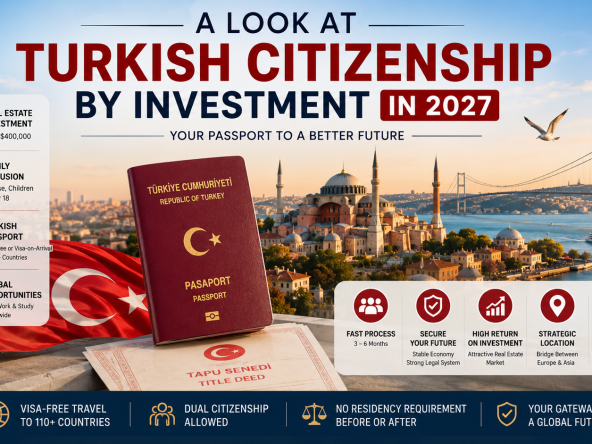
- Zero Tax on Foreign Income for New Residents — for 20 Years Perhaps the most striking measure in the entire package. Individuals who relocate to Turkey and have not held Turkish tax residency in the past three years can qualify for a complete exemption on foreign-sourced income — for two full decades. Italy offers a similar programme, but charges up to €300,000 per year for 15 years. Greece’s equivalent costs €100,000 annually. Portugal’s NHR 2.0 runs for 10 years at a 20% rate. Turkey’s version is free, longer, and uniquely pairs with a citizenship-by-investment programme requiring a minimum $400,000 real estate purchase.
- Inheritance Tax Reduced to 1% For qualifying new residents, inheritance tax drops from 10% to just 1%. The UAE, Singapore, and Cyprus charge zero inheritance tax, but none offers the same path to EU-adjacent citizenship, EU customs union access, or — in the Gulf’s case — a clean geopolitical bill of health. The UK abolished non-domicile tax status in April 2025 and taxes estates at up to 40%. Turkey’s 1% rate, stacked alongside the foreign income exemption, creates a generational wealth management framework that no single competitor currently matches in full.
- Istanbul Finance Center (IFC) Incentives Extended to 2047 Multinationals establishing their regional headquarters within the Istanbul Finance Center receive a 100% exemption on overseas income, with a 95% exemption for companies operating outside the IFC but still within Turkey. These incentives are legislatively guaranteed to run until 2047 — providing the long-horizon certainty that corporate boards require when making HQ relocation decisions. Dubai’s DIFC offered comparable terms, but Gulf risk is now explicitly priced into those decisions. Singapore’s headline rate is 17%. Amsterdam’s is 25.8%. Istanbul now offers a structurally superior alternative at a fraction of the operating cost.
- Full Transit Trade Tax Exemption at the IFC Transit trade earnings processed through the Istanbul Finance Center are now 100% exempt from corporate tax — doubled from the previous 50% exemption. Companies operating outside the IFC receive a 95% exemption. For commodity trading houses, logistics companies, and supply chain managers who historically defaulted to Hong Kong or the Netherlands as transit trade hubs, Turkey’s combination of geographic centrality and 0% transit tax changes the fundamental economics.
- Asset Repatriation at 2–3% with Full Audit Amnesty Cash, gold, securities, and other assets held offshore can be repatriated at a tax cost of 2% to 3%, accompanied by permanent immunity from tax investigation and no source-of-funds questioning. With Swiss banking secrecy effectively dismantled and CRS data-sharing agreements turning offshore opacity into a legal liability rather than an asset, Turkey’s repatriation window is the cleanest capital normalisation mechanism available globally in 2026. It is Turkey’s eighth such programme since 2008, and the terms have never been more favourable.
- One-Stop Company Formation in a Single Day Incorporation, tax registration, work permits, incentive applications, and environmental approvals have been consolidated into a single digital processing hub. One office, one business day, and your company is operational. Singapore has offered this level of administrative efficiency for years. Turkey closing this gap removes one of the few remaining practical arguments for choosing Dubai or Singapore over Istanbul, even when Istanbul’s underlying fundamentals were stronger.
- Duty-Free Machinery and Zero VAT on Strategic Equipment Companies holding strategic investment incentive certificates can import machinery entirely free of customs duty, with domestically purchased equipment carrying zero VAT. Combined with the 9% corporate tax rate and EU customs union access, this makes Turkey’s industrial investment proposition arguably the most complete available in any emerging market globally — more competitive than Vietnam, Poland, or Mexico on a total-cost-of-ownership basis.
Reading the Signal: Who Should Act, and When
The investor profile that benefits most from these reforms spans several distinct groups. High-net-worth individuals and family offices sit at the top: the combination of zero foreign income tax, 1% inheritance protection, and low-friction asset repatriation is a complete wealth architecture that no single jurisdiction currently replicates. Manufacturers evaluating where to build their next export-oriented production facility should run the numbers against every alternative, because Turkey’s 9% rate plus duty-free factory build plus EU market access is a genuinely difficult argument to beat. Multinationals reassessing their EMEA headquarters — particularly those currently based in Dubai — face a straightforward comparative analysis in which Istanbul’s IFC incentives are now quantifiably superior on almost every financial metric.
What makes the timing critical is not the reforms themselves, but the institutional validation that preceded them. When 23 sovereign wealth funds and global asset managers collectively managing $1.2 trillion fly to Istanbul before the reforms are even announced, they are telling the market something. BlackRock did not go to Istanbul for the food. They went because someone with $14 trillion under management saw what the data was pointing to — and moved before the window became obvious to everyone else.
Turkey’s reforms are now law. The window is open. The only meaningful question left is how long it stays this wide.